When I first heard the Albanian language, I must admit it left me rather baffled. Totally unlike any other language I had heard before, it sounded like one long word punctuated with lots of unpronounceable intonations.
The Albanian language or Shqip is spoken by around 6 million people within the Balkans- mainly in Albania and neighbouring Kosova, Macedonia, Montenegro, and Serbia. In Albania itself, the language is spoken by over 3.1 million people, including some bilingual ethnic minorities. As of March 2018, it became one of the official languages of Macedonia, along with Macedonian, due to the large ethnic Albanian population that live there, predominantly in and around the city of Ohrid near the Albanian border. There is also a significant Albanian speaking population in Greece in places such as Boeotia, Levadhia, Euobea, Attica, Corinth and Andros and these speakers are the descendants of Albanian immigrants that travelled there in the late Middle Ages.
Also, in southern Italy, there is a small but well-established Albanian speaking minority known as the Arberesh who are the descendants of refugees that fled Albania after the death of Skanderberg in 1468. These individuals speak an archaic form of Albanian which differs substantially from modern-day Shqip. Large amounts of Albanian speakers can also be found in the wider diaspora such as Germany, Switzerland, UK and North America, particularly New York, Boston, Detroit and Toronto.
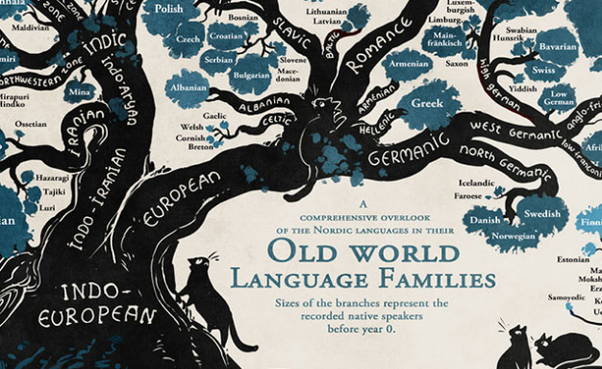
The language itself is its own branch of the extensive Indo-European family and is distantly related to most of the other languages of Europe. That said, it is linguistically distinctive and does not share many similarities with any other language and forms a language group of its own. Despite the geographical proximity to Greece, the linguistic links with Ancient Greek are rather sporadic, likewise with Italy and the Latin language. Whilst there are traces of Latin within Shqip, they are not as prevalent as instances in English, Spanish, and the like.
When it comes to the morphology and syntax of the Albanian language, there are certain links with other Balkan languages, due in part to extinct shared substrata languages such as Illyrian Thracian, and Dacian, and to centuries of parallel development. These similarities include the postpositive definite article, the fusion of the genitive and dative case endings, the formation of the numbers 11-19 by “one-on-ten”, the lack of a grammatical infinitive, and the formation of the future tense with the verb “to want”. Whether the Albanian language is a direct descendant of the ancient Illyrian language is quite difficult to determine as very few records of the language exist, but it is broadly assumed to be the case.
There are two main dialects of the Albanian language that are used in different parts of the country. Gheg[is used in the north and Tosk in the south with the Shkumbin River that flows through Elbasan into the Adriatic, forming the approximate boundary between the two dialect regions. Gheg is characterised by the presence of nasal vowels whereas Tosk is much softer on the ears. Standard Albanian, a mixture of the two is structurally similar to most other Indo-European languages; nouns are marked for gender, number and case, as well as having definite and indefinite forms. Most nouns are masculine or feminine although there are some rare cases of neutral nouns that often function as masculine in the singular and feminine in the plural.
Personally, I think it is a beautiful language and once you begin to understand the sounds and some of the words, you can make much more sense of the sentences you hear. There are many ways to say many different things and whilst it can sound rather vociferous at times, I think generally sounds incredibly soft and lyrical.
If you are coming to Albania, or you are one of the expats that live here but has not made an effort to learn the language yet, here are some important phrases and words that you should learn.
How are you?
Si jeni? (see YEH-nee?)
Greeting
Pershendetje (per shen det yuh)
Well, thanks.
Jam mirë, faleminderit. (yahm-MEER, fah-lehm-meen-DEH-reet)
Pleased to meet you.
Më vjen mirë. (muh VYEHN MEER)
Please.
Ju lutem. (yoo LOO-tehm)
Thank you.
Faleminderit. (fah-lehm-meen-DEH-reet)
You’re welcome.
S’ka përse. (skah purr-SEH)
Yes.
Po. (poh)
No.
Jo. (yoh)
Excuse me. (getting attention or as a general apology)
Më falni. (mah FAHL-nee)
Goodbye
Mirupafshim (meer-oo-PAHF-sheem)
Good morning.
Mirëmëngjes. (meer-muhn-JEHS)
Good afternoon/Good day.
Mirëdita. (meer-DEE-tah)
Good evening.
Mirëmbrëma. (meerm-BRUH-mah)
Good night.
Natën e mirë. (NAH-tehn eh MEER)
Learn them and use them!
Follow The Balkanista!